Showing posts with label Narcissus. Show all posts

Narcissus Fly: The Ugly Truth

 A chastening, unpleasant image today as I reveal the murky secrets of the Narcissus Fly larvae. They make a home out of a nice plump snowdrop or narcissus bulb that serves them as food and shelter through the winter. This little dwelling is or was 'Pieces of Eight' - a warning for those who fork out lots of cash for the latest varieties of snowdrops. For the record, it is possible for a bulb to survive although in the case of smaller bulbs, and this one, I rather doubt it. I live in hope. Whatever, from top down: bulb, grub, adult fly. Pretty things aren't they. There does not appear to be a pesticide on the market to deal with the pest. Prevention is better than cure I read though how one might practically whack every passing two winged bumblebee (real bees have four wings) is beyond me. 


Narcissus 'Corby Candle' - Division 2

 I once read an article about the threats posed by bright, modern daffodils encroaching on the traditional more subdued flowers of Ullswater, immortalised in William Wordsworth's poem. 'Corby Candle' is too bright for the Cumbrian lake. A hybrid from the Northamptonshire enthusiast, John Gibson in 2003, this is a vibrant highlight in the Spring border. John is very active in the Daffodil Society. Indeed, should you require a copy of the latest RHS Daffodil, Snowdrop & Tulip yearbook,  John is the port of call. One of my favourite modern narcissus.

Omphalodes Cappadocica ‘Cherry Ingram’

 A lovely plant for a shady position today. Omphalodes Cappadocica ‘Cherry Ingram’ was purchased from a plant stall at a local fair and it may not be the named variety. However it flowers in the most shady part of the garden and whereas it perhaps does not have the density of flower it might attain in a more favoured position it does lighten up our side gate area beside a dark purple hellebore and holly bush. Photographed on 3rd April.


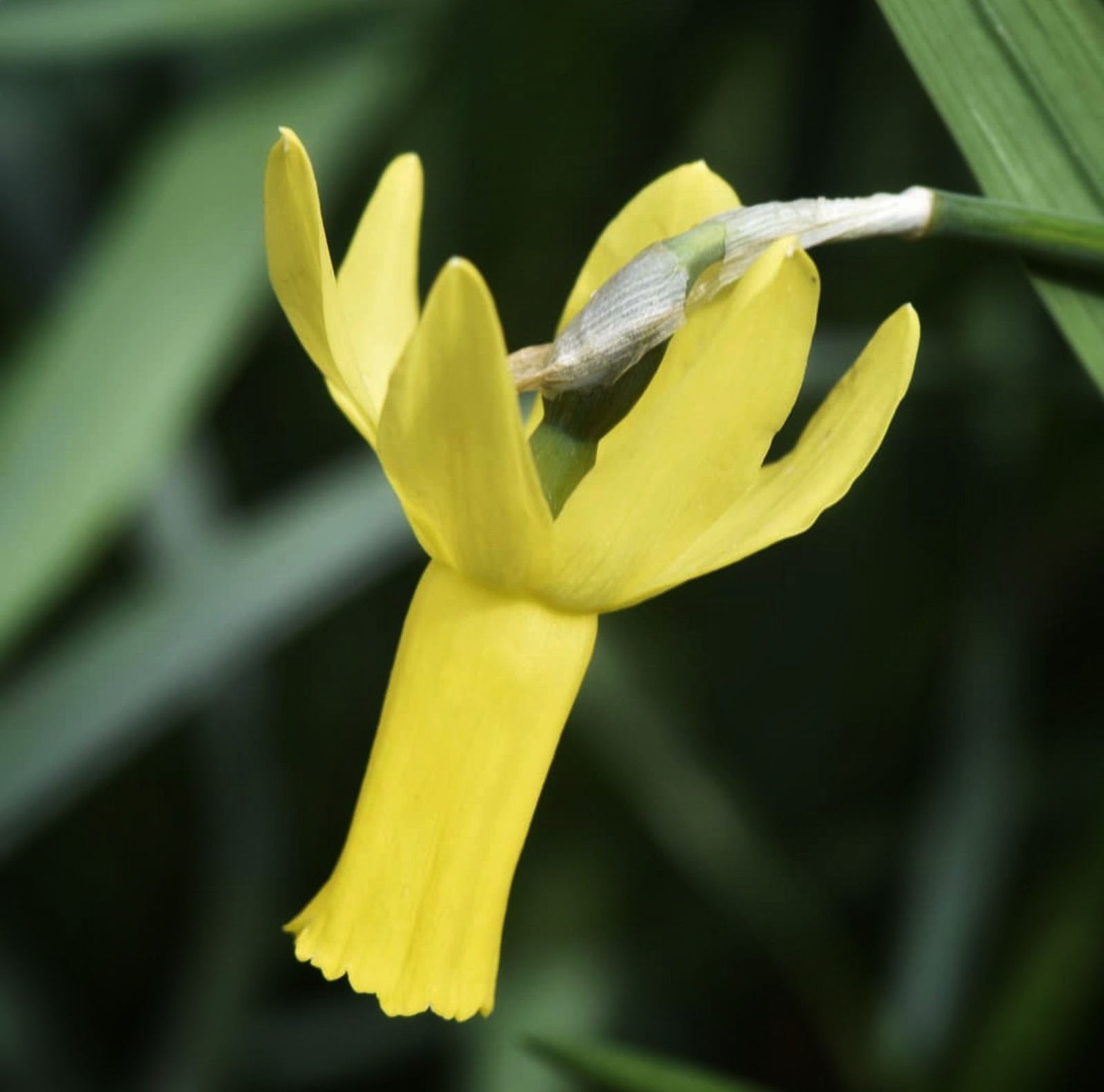
Narcissus 'Jenny' - a beautiful daffodil

 We tend to believe the best plant varieties are the products of modern hybridisers, learning from mistakes, breeding from a huge stock. In the case of the cyclamineus 'Jenny', photographed on 29th March, the breeding goes back to 1943 by the English writer and grower, Cyril F. Coleman. The relexed petals are a milky white and the trumpets a slightly deeper cream, after an initial dalliance with a lemon yellow. I love this daffodil and certainly it is a favourite. In the fifties and sixties Cyril F. Coleman was one of the RHS's leading experts on narcissus and tulips, the author of several books on bulbs, one of which is featured below.


My Snowdrop Year

 I'm attempting to move my snowdrops from pots to borders out of necessity.  I have too many. However in the meantime here is a photograph of one of the racks replete with weeds to trigger a quick synopsis of my snowdrop year which commences after flowering when I split up the clumps and, in this case, transfer from pot to border. The second image shows a newly planted area of the garden, beefed up with compost and divided snowdrops, cyclamen and daffodils. If I remember I'll feature this very spot in the spring. The pots have been fed with slow release fertiliser, so all I do is water them frequently.  I have discovered the perils of compost drying out when the bulbs are busy plumping up. After the bulbs go into dormancy I repot at my leisure, mixing potting compost, grit and vermiculite. This can be an ordeal as it is depressing to root through compost to discover not discover a solitary bulb, perhaps the remains of bulbs or grubs of the narcissus fly. E.A. Beale has disappeared  from two pots, the third and final time I'm growing the damn thing. Anyway, I discard any soft ones, and where there is any sign of rot apply a fungicide I was given by a friend. About now the autumn flowering ones are placed in a prominent position and I move the rest into a sunny area. Labels are a bete noire because they go walkabout. Then of course there's the little matter of adding to my collection. I only have three new ones this year, a major change. Only very distinctive snowdrops will be added. I've certainly started to diversify. Bavk to the photograph of the pots. Plastic pots on top, terracotta ones at the bottom to ballast the racks. I'm not risking another collapse. And finally, the last man standing this year, a little glum in the wet.


Narcissus Van Sion, Division 4, Double Daffodil

 I have featured some old varieties of narcissus on these pages though no older than Van Sion, chosen to illustrate Division 4, the double daffodil of garden origin. The description is defined thus: More than one flower per stem, with doubling of the perianth segments or the corona (or both). This ancient variety is very variable, indeed it can have a distinctly green cast and I had neater specimens than this, photographed on 20th March. In his seminal 'A Handbook of Narcissus', published in 1934 EA Bowles gave a historical perspective on the age and origins of this great survivor: “Its first appearance in England is that chronicled by Parkinson, who tells in the Paradisus that Vincent Sion, a Fleming, living in London, cherished it in his garden for many years before it flowered in the year 1620. He thought that John de Frauqueville might have given him the bulb, but that worthy disclaimed the honor, never having seen the like before." Tough as old boots and very reliable, there's a certain charm in having such an historical bulb in our garden.


Narcissus 'Cape Cornwall' Division 2 Large-Cupped

 A recent post concerned the demise of Cornwall's world renowned bulb industry as the world famous daffodil fields were grubbed out for food production during WW2. I thought about this and remembered that Cornwall still has one of the world's top hybridisers in Ron Scamp - the link is to a 'Country Life' article about him. So appropriately enough I chose one of his introductions 'Cape Cornwall' as representative of Division 2, large-cupped daffodil cultivars - one flower to a stem; corona (cup) more than one-third but less than equal to the length of the perianth segments (petals). 'Cape Cornwall', photographed here on 13th April, was introduced in 1996 and, true to type, has a large flower that is very bright and modern. Ron sells his bulbs by mail order and has plenty of new introductions, sadly sold out as I write.

Narcissus 'Avalanche of Gold' Tazetta - Division 8

 I set out to see if I had representatives of all the 13 different classifications of narcissus varieties. Today it is the Tazetta daffodil and a tribute to the breeder of the very lovely 'Avalanche of Gold',  William R. P. Welch who died in February at the age of 61. First the classification. This is a showy category, defined as 'usually three to twenty flowers to a stout stem; perianth segments spreading not reflexed; flowers usually fragrant'. I have several and was tempted to feature the well known 'Minnow' or 'Silver Chimes'. But 'Avalanche of Gold' won the day. A spectacular garden plant, photographed here on 22nd March, it has a spicy scent and between eight and fifteen flowers to each stem. Growing and selling his bulbs in Santa Cruz, Bill 'Bulb Baron' Welch seems to have been quite the character as his orbituary demonstrates. He was a witty man and a bright one, winning several major chess championships. His bulbs were his 'bildren'. Given that the bulbs take up to seven years to raise from seed, he had a work ethic as well as wit. In 2019 he was awarded the Gold Medal of the American Daffodil Society. The image is of Bill taken from the society's webpage. 


Narcissus 'Park Springs' Division 3

 Another daffodil and another division in my journey through the classifications of this most wonderful of bulbs: Narcissus 'Park Springs' glorious, early flowering variety - the photograph was taken on 19th March. Division 3 is defined as 'One flower per stem; corona not more than one third the length of the perianth segments.' To shorten it, this is the small cupped class. 'Park Springs' stood out in the garden. It was bred in Herefordshire by Mrs Barbara J. Abel-Smith, 1914-1995, and introduced to her catalogue in 1973. Barbara published a very comprehensive catalogue, selling many varieties, some of which were her own. 'Park Springs', from a cursory inspection, seems to have been her most successful introduction. She published catalogues up until 1992, most of which are on-line. She was awarded the American Daffodil Society Gold Medal in 1991. The detail below is from her 1988 catalogue, listing the plant's show successes, followed by a similar snip from the 1973 catalogue when it was introduced.


Narcissus 'Spoirot' Division 10: Bulbocodium hybrids

 I love the hoop narcissus though I've lost a few tiny varieties over the years. 'Spoirot' is very attractive and very reliable. Definition first: usually one flower to a stem; perianth segments insignificant compared with the dominant corona; anthers dorsifixed (ie attached more or less centrally to the filament); filament and style usually curved. In summary, dispense with the petals, concentrate on the cup. To illustrate the form, I've chosen 'Spoirot', a miniature bred by Rob Barwick from Brook Bulb Farm in Tasmania,  Australia. A self confessed one man band, Rob is one of Australia's leading hybridisers of narcissus. He was featured in an article for the American Daffodil Society in 2008, the relevant section follows a snippet from his 2000-2001 catalogue. Finally, I've just read a finely illustrated 2016 article from the Alpine Garden Society Victoria Group Narcissus the Dwarf Forms featuring some bulbs originating from Brook Bulb Farm. It has provided me with a shopping list too, particularly Narcissus Ben 'Bler a cross between 'Spoirot' and another great hoop 'Julia Jane'. Rob considers it his finest cross. I have the latter though I am unable to find 'Ben 'Blur' here in the UK. I have to say it has been interesting finding out about these men and women whose dedication, interest, patience and knowledge have given us these superb varieties of narcissus.


Narcissus Actaea - Poeticus - Division 9

 Continuing my trail through the different divisions of daffodil, Narcissus Actaea is another 'heirloom' variety dating back to before 1919. It represents the poeticus, division 9. Perhaps the most ancient of daffodils, this may be the variety that Persephone was picking when Hades abducted and stole her away to the underworld. From the official description: 'usually one flower to a stem; perianth segments pure white; corona very short or disc-shaped, usually with a green and/or yellow centre and a red rim, but sometimes of a single colour; flowers usually fragrant'. Actaea fulfills all the features of its division with an emphasis on the fragrance. It has been a top performer in our garden for years. 


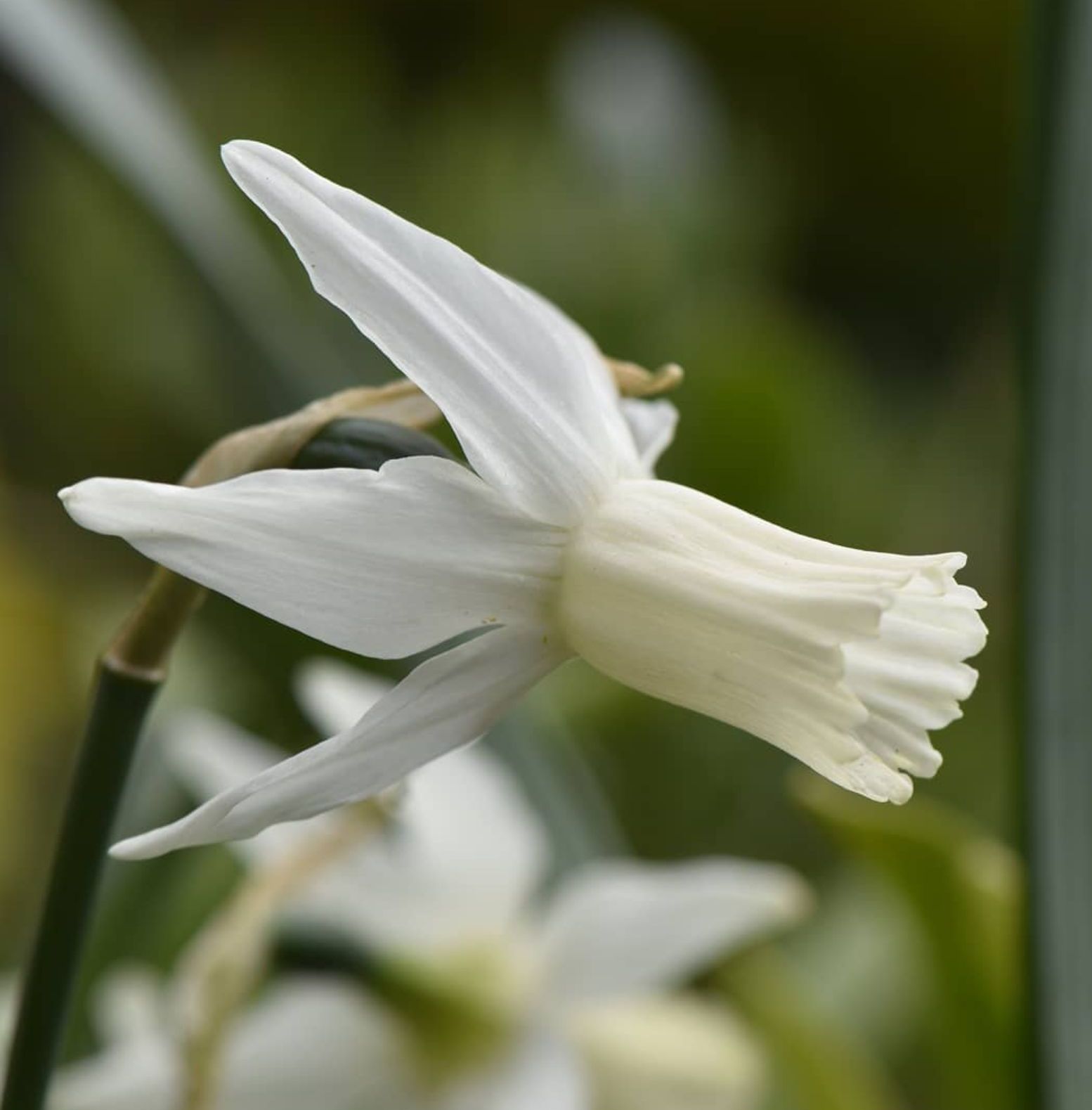
Narcissus 'Peeping Tom' - Cyclamineus, Division 6

 Daffodils are classified into thirteen different divisions. I don't have an example of all of them but I'll work my way through a few in the next few weeks. Division 6 today, the cyclamineus. Typically miniature with swept back, reflexed petals and a very straight trumpet. The name is easy: they resemble cyclamen in shape. 'Peeping Tom' is a good example and very useful in our garden as it looks fabulous and increases readily. Plant and forget. I never intended it but the narcissii I have featured lately have been older varieties, this one going back to pre-1946, bred in Cornwall by Percival D Williams who died in 1935. Percival was one of the great plant breeders. 'Carlton', the world's best selling daffodil bulb was one of his hybrids. Until the 2nd World War when the daffodil fields were grubbed up in favour of food crops, Cornwall was the centre of the daffodil cultivation shipping out bulbs right around the world.  Thousands of his seedlings were tested in the Netherlands and they have taken on the mantle of world leaders in the industry at Cornwall's expense. We've never recovered our ascendancy though 'Peeping Tom' has certainly stood the test of time. I have included a photograph of tgevgreat man taken from an interesting 2018 pamphlet from daffilibrary.org. 


Miniature Narcissus 'Flomay'


One of the top breeders of daffodils was Alec Gray, 1895-1986. He brought us 'Tête-à-Tête' for example, the greatest success of any bulb. 'Flomay' was named after his wife. Now you only name something after your wife if it is special and it is. Photographed here on 1st April 'Flomay' is a fabulous miniature, looking great in a pot. It is very slow to increase. Here's Alec's own description in his 1960 catalogue. I'm waiting for that pinkish edge to develop.


Narcissus 'Kiwi Magic'

 There are thousands of narcissus varieties. However 'Kiwi Magic' is rather special, an enchanting mix of yellow and cream, a ruffle rather than trumpet. Were a confectioner or dress designer to conjure up a little something ... Introduced in 1989 the bulb was one of the finest raised by the small business, Koanga Daffodils, based in Hamilton, New Zealand. Indeed, I have the description from their final ever catalogue for 2007-2008. 

'A stunning double that just keeps on winning! Twenty National premier blooms to its credit, including 2003, and Best Bloom at the Canberra Australasian Championship in 1994. A huge flower pure white with lemon inner segments that fade to milk white as it matures. Very evenly formed — a stand out amongst its peers.'

Interestingly, the most expensive bulb they sold was 'Fencourt Jewel' at $150, New Zealand currency. It is available in the UK, very much cheaper, and I'll put it on the list for next year. So these lovely varieties don't just happen. Thanks to Peter and Lesley Ramsay and Max and Kath Hamilton - Koanga.


Narcissus 'Sabine Hay' - The Future's Orange

 One of the brightest and most unusual narcissus I grew for the first time last year was 'Sabine Hay'. Its orange petals and darker cup are just startling. I planted it in a large terracotta pot in the shadiest section of the patio to preserve its colour. The bulb is no kid on the block having been bred in the 60s. To the best of my knowledge no other narcissus has this colouring. I planted some annuals in the same pot and, clearing them out before top dressing, the new shoots are already sprouting. The photograph was taken on the 28th March this year.


Narcissus 'Lundy Light'


 I have grown to love narcissus varieties that are not freely available in the local garden centres. Each year I buy a few more. Next year promises to be a bumper one because I ordered in lockdown, early, and so my order was completely satisfied. The new ones are potted up, the old ones planted in the garden. But back to this spring: 10th April.  'Lundy Light' is well named: a bright beacon of colour. The corona is a bright red. Frankly I don't enter the competitions and the different classifications and categories of narcissii are not something I've taken heed of. If I was entering a pot of daffodils at a show this bright variety would be a contender. Vigorous and oh so cheerful.

Lilium 'Lady Alice' and the enemy

Our garden has been changed over the period of lockdown through Covid 19. Obviously I have had more time for the garden. Shrubs and indeed trees have been cut down to allow in even more light into what was a dark part of the garden. The spur was the removal by our neighbours of a row of towering leylandiis that sapped nutrients from the soil and light from the skies. So new plants can be introduced and it's been a renaissance and an opportunity. Lilies are spectacular plants and I'm always discovering new varieties. 'Lady Alice' is new to me, a bulb grown from seed. But notice the red lily beetle. These pests devastate lilies and indeed fritillarias. If you track them down they drop to the soil. Still, it is a satisfying experience to crunch them between fingernails. However I confess I've resorted to insecticides and they work. A nice variety though without the strong perfume that is such a feature of lilies.


Plants in flower or just barking at Bodnant Gardens

Despite the snow there was plenty to see at Bodnant yesterday. In winter the colour of the bark is as important as the flowers. I did not get the name of the arbutus but in the dappled sunshine it looked a treat.


The flowers of this rhododendron dauricum are of course essential to its beauty.

Wintersweet, or more precisely Chimonanthus praecox, has an insignificant flower, making its impact with the sweetness of its perfume, carried well in the cold Welsh air.

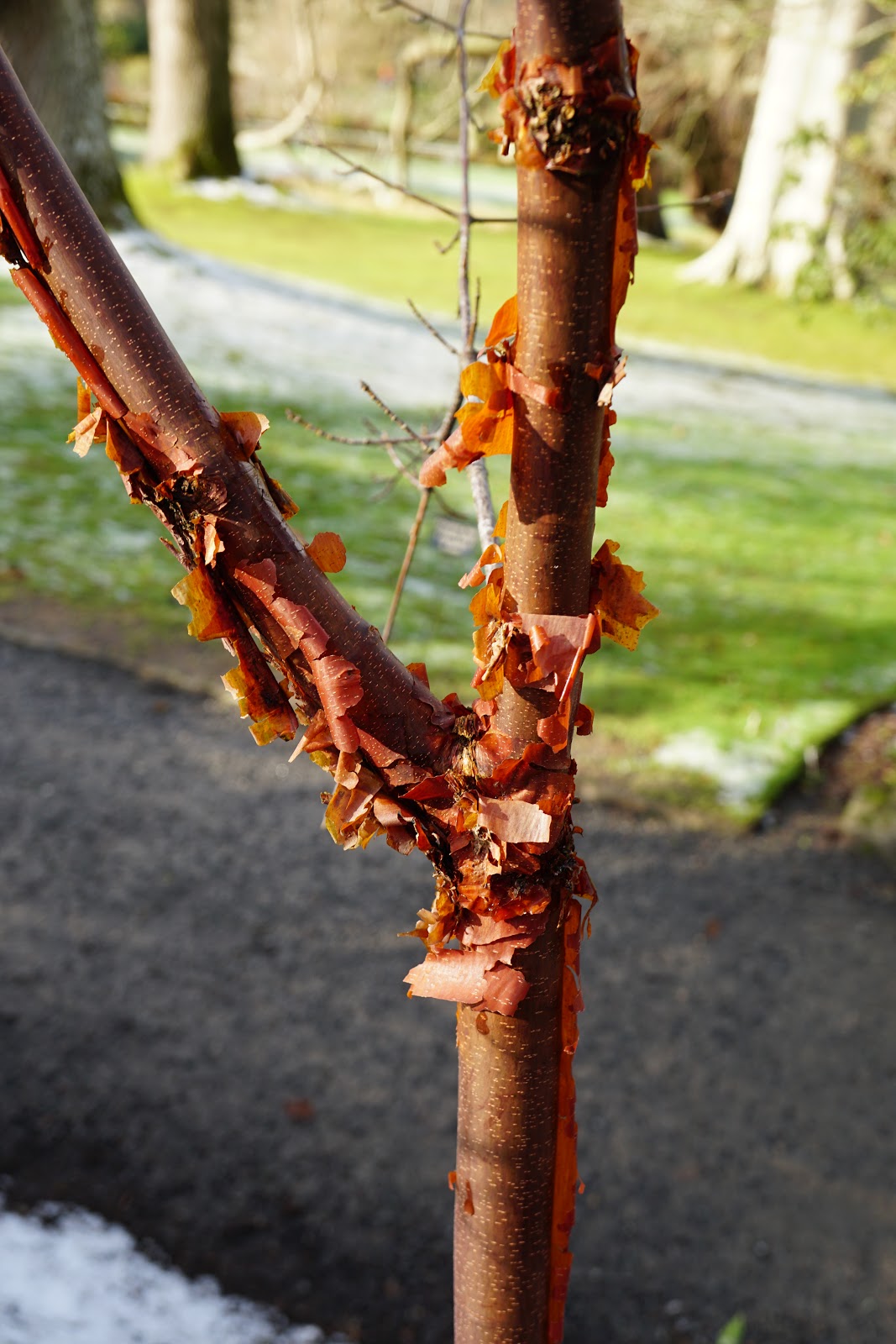
This time the Acer griseum provides the colourful bark.


And the birch, Betula ermanii 'Grayswood Hill'.


Dogwoods and ericas always give good value for money at this time of the year, the yellow, green and red stems reflecting the sunlight.


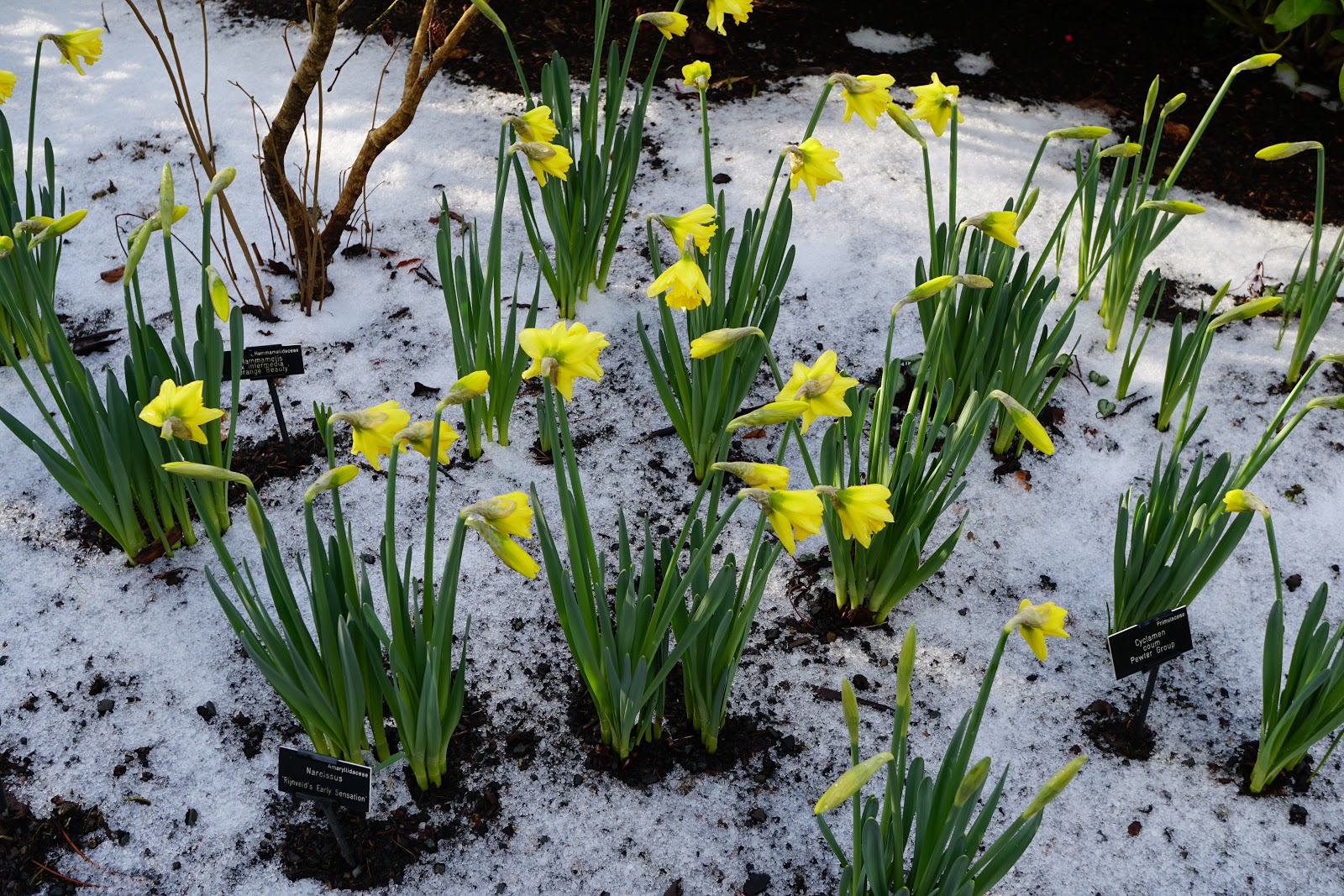
Rijnveldt's Early Sensation was planted all over the extensive gardens and are truly one for the early garden.

 Last year I very nearly bought the hellebore, 'Penny's Pink'. This year I wish I had.

Hamamelis x intermedia 'Feuerzauber', and the warm brightness of  'Iwato' through the sunlight.

Finally, as I draw an end to what amounts to a shopping list, a lovely fresh euphorbia, characias 'Wulfenii'.


Narcissus 'Jetfire', 'Velocity' & 'Canaliculatus'

Two stunning and very similar narcissus varieties  are the well known and widely available 'Jetfire' and the less well known 'Velocity'.  Atrocious weather has not affected the former in any meaningful way. They have withstood wind, hail, snow and ice. And that was just yesterday. 'Velocity' has the slightly larger flower and is just as long lasting although later than 'Jetfire'. Quite frankly the bright narcissus are needed to lift a dismal Spring. They have increased well.


Narcissus 'Canaliculatus' looks similar in size in the photographs but images can lie. It's a tiny flower, dainty and pretty.


Narcissus 'Altruist': early, sweet and long lasting

Narcissus 'Altruist'  was described in the catalogue as April flowering. Well it is despite having been in bloom since February. Perhaps the absolute freshness has gone out of the blooms, but it was photographed yesterday at 6.30pm on a gloomy day and it still evinces the colour of summer, a scare commodity this spring. Tall and elegant, they stand upright in the large containers for my clematis varieties. Indeed, they were planted as an afterthought after their original container disintegrated in last year's frost. I'd forgotten about them and suddenly in the February frosts and snow they were in flower, drooping dramatically until the temperatures rose and, like springy plastic, they jumped up to attention again. And I have not yet mentioned the sweet fragrance. The catalogue never mentioned it either. Descriptions vary. Some sellers declare it is non-fragrant, some fragrant. Mine are the latter variety of the variety. As long lasting as the snow that is falling on a dire Easter Monday.


And remembering .....

Galanthus 'Mighty Atom'