
Showing posts with label Hepatica. Show all posts
Showing posts with label Hepatica. Show all posts
Hepatica japonica f. magna seedlings
Hepaticas are the most expensive plants. Frankly, for anyone but absolute experts and an alpine house, paying hundreds of pounds for the exquisite double, named forms, is a game for the very rich. However the range of colours of the Hepatica japonica f.magna make for a delightful addition to the early spring garden. In the pot below I added a few seedlings to brighten up what had been full of cyclamen coum. This was pictured on 16th March. I notice flower buds are already forming for this winter.
Hepatica japonica Gosyo-Zacura
Hepaticas are miniature jewels and temperamental ones in my garden. I lose a few and given the cost I'll leave it for the specialists. Hepatica japonica Gosyo-Zacura grows in a sheltered spot in the garden where it has protection from the summer sun. It has sent out new shoots so I know it's still with us. The photograph was taken on the 11th March. Hepaticas look best when the flowers festoon the plant though I liked this one for the texture in close-up.

Narcissus 'Altruist': early, sweet and long lasting
Narcissus 'Altruist' was described in the catalogue as April flowering. Well it is despite having been in bloom since February. Perhaps the absolute freshness has gone out of the blooms, but it was photographed yesterday at 6.30pm on a gloomy day and it still evinces the colour of summer, a scare commodity this spring. Tall and elegant, they stand upright in the large containers for my clematis varieties. Indeed, they were planted as an afterthought after their original container disintegrated in last year's frost. I'd forgotten about them and suddenly in the February frosts and snow they were in flower, drooping dramatically until the temperatures rose and, like springy plastic, they jumped up to attention again. And I have not yet mentioned the sweet fragrance. The catalogue never mentioned it either. Descriptions vary. Some sellers declare it is non-fragrant, some fragrant. Mine are the latter variety of the variety. As long lasting as the snow that is falling on a dire Easter Monday.


Looking Down on Phil and Barbara: Galanthus 'Phil Cornish' and 'Barbara's Double'
I take a lot of photographs of snowdrops at eye level, so as best to appreciate their finer points. Of course, the natural viewpoint is from above so here are two snowdrops I have written about previously, 'au naturel': 'Phil Cornish' and 'Barbara's Double' are shown directly from above so it's hardly natural, just another perspective. Don't they make a bonny couple! I'd venture to suggest the former is one of the nicest marked snowdrops on the market. It's not a cheap buy but better than some, possibly all, that I have seen for huge sums on eBay or at plant fairs. 'Barbara's Double' is one for the collection, just such a pretty snowdrop.
 When one pays a pretty sum of money for a single snowdrop cultivar it is reassuring to know that s/he will not stay single for long, and one hopes for large families. Such is the case with the very handsome Galanthus nivalis poculiformis, often referred to simply as 'poculiformis'. It is a pure white form possessing six petals and is particularly good when fully open which today it was not. That apart it is towards the inexpensive end of the Poculiformis Group or, for those whose education was unhampered by Latin lessons, 'little cup' from the Latin 'poculus'. I studied Latin to a decent level at school but believed the form denoted something to do with all white flowers. I should have studied harder for it refers to the form where the inner and outer petals are very similar. So my little fellow may be forgiven for the spot of green on the inner petal. I digress. The original bulb has clumped up very well indeed.

And another hepatica is in flower, the Hepatica japonica 'Imaizumi'. There is a huge range of such varieties sharing one thing in common: they're not cheap. So my collection is limited and will remain so until and if they seed themselves as did the seedling that closes today's blog. it is minuscule in reality.


And another hepatica is in flower, the Hepatica japonica 'Imaizumi'. There is a huge range of such varieties sharing one thing in common: they're not cheap. So my collection is limited and will remain so until and if they seed themselves as did the seedling that closes today's blog. it is minuscule in reality.


Hoops and Hepaticas
Normally I have little problem deciding which plant to feature first: I normally go with the more spectacular. On a brilliantly sunny if chilly morning there was no problem. Returning home this afternoon, another plant took my eye. So in no particular order .... Hepatica japonica Haato no Kingu is spectacular with a cluster of showy flowers startling in that they brave the cold without the unaffordable alpine house. I give more attention to hepaticas than any other plant. This one is sited in the most sheltered and sunny part of the garden during the cold months and I give it shade in summer as it needs moisture. In nature it would sit under trees, only obtaining direct sunlight in early spring before the leaves unfurl. Narcissus 'Lemon Flare' was photographed first thing this morning, delectable despite a light frosting. From grass-like shoots, hoop petticoats emerge in profusion if well grown. In the last few years I have become a fan and even my family notice them, not necessarily the case with all our plants. 'Yes, Dad, did I tell you about the er yawn.' (Our grandson takes another approach: 'It was the ball's fault.')


Hepatica Japonica Momohanabi
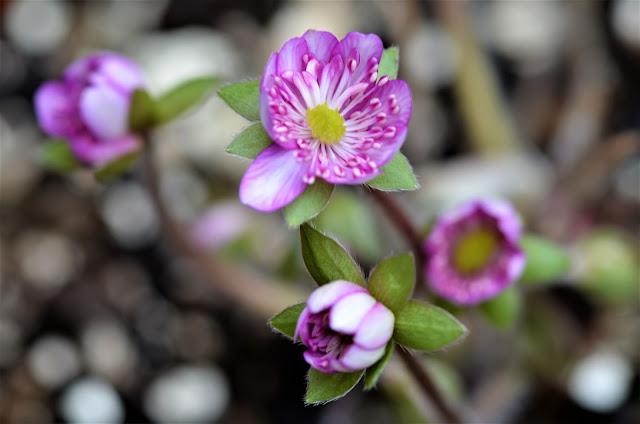
They are tricky beggars to grow properly. However, Hepatica japonica Momohanabi has just commenced flowering and I hope for a mass of the tiny, jewel like flowers. I am experimenting with the best place to plant them. At the moment the highly regarded plants reside in a sunny position though I have lost several in the past when they have either dried out or been waterlogged. Momohanabi is a named variety, rather choice. I have some interesting unnamed doubles. They are so exotic they seem out of place in the winter garden. Lovely though.

I was a little dissatisfied with my images of this little plant and this afternoon (Monday) decided to redo them. So first up is a photograph set against a more colourful background, the one below sitting on the outside windowsill. You can see why the Japanese have developed the culture of these little plants into something of an art form.


Subscribe to:
Posts (Atom)
