I once read an article about the threats posed by bright, modern daffodils encroaching on the traditional more subdued flowers of Ullswater, immortalised in William Wordsworth's poem. 'Corby Candle' is too bright for the Cumbrian lake. A hybrid from the Northamptonshire enthusiast, John Gibson in 2003, this is a vibrant highlight in the Spring border. John is very active in the Daffodil Society. Indeed, should you require a copy of the latest RHS Daffodil, Snowdrop & Tulip yearbook, John is the port of call. One of my favourite modern narcissus. 
Showing posts with label Plant Breeders. Show all posts
Showing posts with label Plant Breeders. Show all posts
Narcissus 'Corby Candle' - Division 2
Narcissus 'Jenny' - a beautiful daffodil
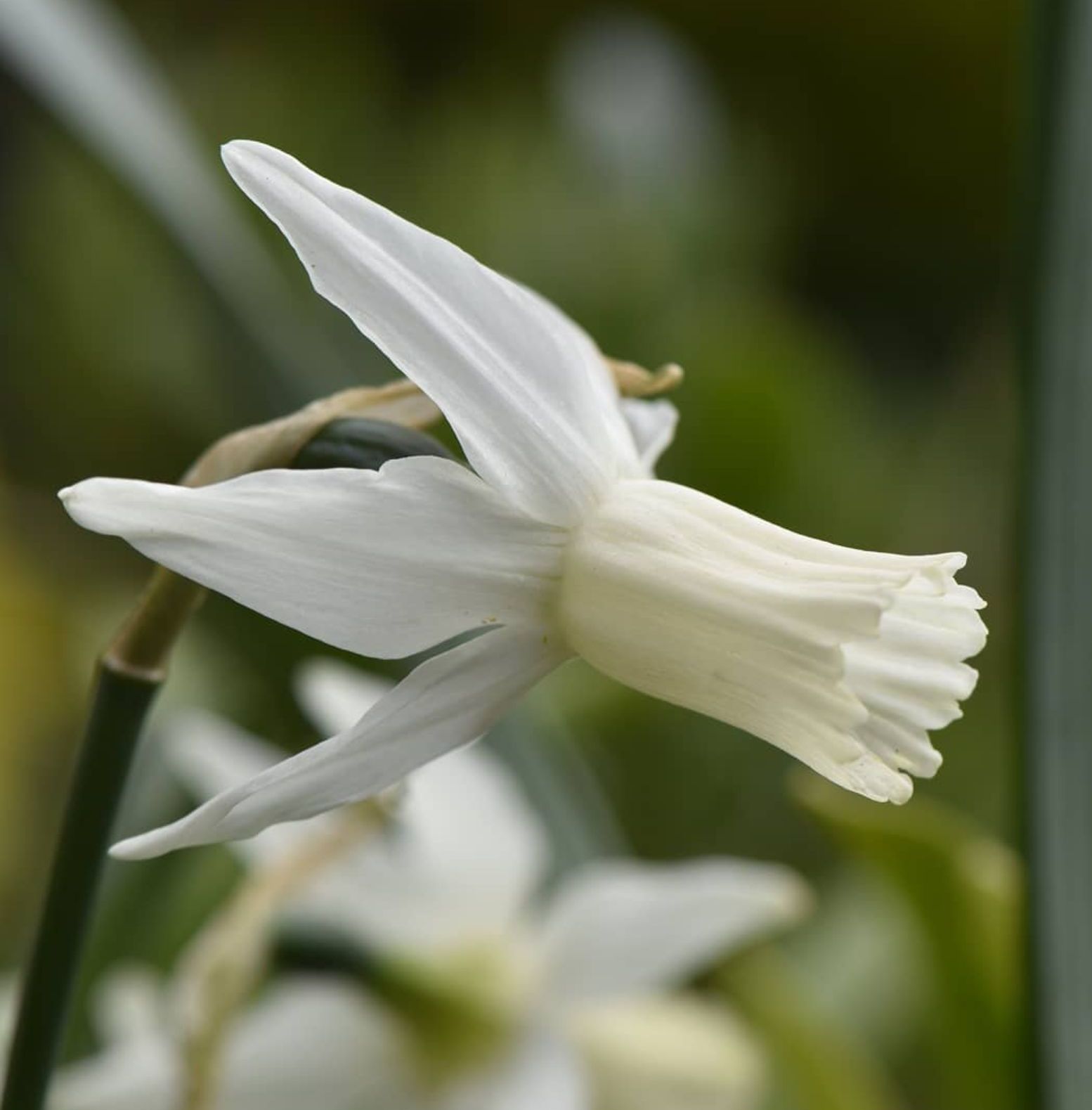
We tend to believe the best plant varieties are the products of modern hybridisers, learning from mistakes, breeding from a huge stock. In the case of the cyclamineus 'Jenny', photographed on 29th March, the breeding goes back to 1943 by the English writer and grower, Cyril F. Coleman. The relexed petals are a milky white and the trumpets a slightly deeper cream, after an initial dalliance with a lemon yellow. I love this daffodil and certainly it is a favourite. In the fifties and sixties Cyril F. Coleman was one of the RHS's leading experts on narcissus and tulips, the author of several books on bulbs, one of which is featured below.

Rosa 'Birthday Girl' - Top Performer
Redesigning the garden has meant sacrificing some roses. However 'Birthday Girl' is not one. It has been a magnificent rose, repeat flowering in profusion, fresh and bright. I have read that it makes a good hedging plant: true enough I'm sure but for me it is a feature not a boundary. Standing at a modest 3ft it needs no support and seems disease free. It was bred by that prolific French nursery Meilland and released in 1992. A good, commercial name too for that garden centre birthday gift. I photographed it on 20th May when it first bloomed and it continued to autumn. Meilland has been around since 1850 and bred some mammoth successes - 'Peace' ('Madame A Meilland'), 'Papa Meilland'.

Gloriosa 'Tomas De Bruyne'
Gloriosa 'Tomas De Bruyne' has a great name for a plant. Flemish, or northern France. A touch of class. And judging by the image taken on the 26th August it looks sensational. Of course it was an impulse buy, an addition to a more considered order. And I gave it the prime spot in a huge terracotta pot on a south facing wall. When it arrived it was an untidy cigar shape and size, wrapped up in tasteful brown paper. But this, dear reader, was the solitary bloom. I'd been fascinated by the thin leaf that eventually developed a wire-like tentacle to grasp the trellis. And, by gosh, it gets the full treatment in the publicity campaign. It was named after an international floral designer by its Dutch breeder, Van Ruiten. Gloriosa is a form of Colchicaceae, a tender South African lily and I think that's the problem with my cultivation. Its natural home is a frost free greenhouse and, despite the warmest outdoor position I can offer, it seems not to have been hot enough. And it arrived a little late to get started properly. It has been stored and insulated for the winter and in the new year I'll get it started early because that first and only bloom was truly breathtaking. A challenge.

Harlow Carr's Rudbeckia Trial
My wife's favourite flower is the Rudbeckia. Well, certainly for autumn though I'll punt for the dahlia. It cannot be denied that the burst of beaming yellow dominates the border in September and October. They look sensational. The photographs were taken on 31st August at RHS Harlow Carr from their trial of varieties grown from seed. They intend to leave them to see how many of the annuals survive the winter. Sadly I note that Thompson and Morgan have sold out of their mixed seed. Chiltern Seeds have their own mix however.


Narcissus Van Sion, Division 4, Double Daffodil
I have featured some old varieties of narcissus on these pages though no older than Van Sion, chosen to illustrate Division 4, the double daffodil of garden origin. The description is defined thus: More than one flower per stem, with doubling of the perianth segments or the corona (or both). This ancient variety is very variable, indeed it can have a distinctly green cast and I had neater specimens than this, photographed on 20th March. In his seminal 'A Handbook of Narcissus', published in 1934 EA Bowles gave a historical perspective on the age and origins of this great survivor: “Its first appearance in England is that chronicled by Parkinson, who tells in the Paradisus that Vincent Sion, a Fleming, living in London, cherished it in his garden for many years before it flowered in the year 1620. He thought that John de Frauqueville might have given him the bulb, but that worthy disclaimed the honor, never having seen the like before." Tough as old boots and very reliable, there's a certain charm in having such an historical bulb in our garden.


Meconopsis 'Mop Head'
The blue poppy is the great Houdini in my garden because it has perfected a disappearing act. I'm in the process of completely redesigning the front garden, eliminating the island bed and widening a border to compensate. Scrabbling around for specimens to relocate I have been disappointed to discover two varieties have just disappeared without trace. Still, two specimens are left and 'Mop Head' was the earliest and though it has died down now there's life there yet for another year. Meconopsis are short lived plants however and, to make matters worse, 'Mop Head' produces little seed. (I must divide it up in Spring!) It is a classy looking variety however with very large upright flowers and it flowers earlier than most. The photograph was taken on the 11th May. A couple of years ago we saw the trial of blue poppies at RHS Harlow Carr. I noted the name and was not surprised when I discovered it had the coveted AGM. However 'Mop Head' has been around for years. In the 1980s Liz Young acquired the seed from an exchange scheme with members of the Scottish Rock Garden Club, naming it in 2007, the first link being to the Meconopsis Group. I'd recommend both groups. I'm a member of the first.

Galanthus 'South Hayes'
'South Hayes' was for a time the most expensive snowdrop in our garden - nowadays I tend to swap but that's another story. I've had the bulbs for years and, truthfully, they are more beautiful than many recent varieties costing far more. Unlike the narcissus I have been writing about lately 'South Hayes' was not the result of painstaking hybridization. It was discovered in 1992 in the Oxford garden of Primrose Warburg, a noted galanthophile, and husband, William Frederic ‘Heff’ Warburg, a professor of Botany. The rear garden slopes dramatically and in the trenches of moist soil the plants seeded freely. The lovely yellow snowdrop, 'Primrose Warburg', named after the owner was another chance seedling. Interestingly, the now rather neglected garden has just been redesigned by Sarah Naybour Design. I've reproduced a 'before and after' photograph. An interesting article about Primrose is that in The Gardener's Apprentice. The photograph was taken on 21st February.


Narcissus 'Cape Cornwall' Division 2 Large-Cupped
A recent post concerned the demise of Cornwall's world renowned bulb industry as the world famous daffodil fields were grubbed out for food production during WW2. I thought about this and remembered that Cornwall still has one of the world's top hybridisers in Ron Scamp - the link is to a 'Country Life' article about him. So appropriately enough I chose one of his introductions 'Cape Cornwall' as representative of Division 2, large-cupped daffodil cultivars - one flower to a stem; corona (cup) more than one-third but less than equal to the length of the perianth segments (petals). 'Cape Cornwall', photographed here on 13th April, was introduced in 1996 and, true to type, has a large flower that is very bright and modern. Ron sells his bulbs by mail order and has plenty of new introductions, sadly sold out as I write.

Dahlia 'Yellow Star'
There are plants that generate their own inner light and the truly exquisite dahlia 'Yellow Star' does just that. I cut down the plant this afternoon with a heavy heart as it was still laden with blooms. However contractors arrive any day now to remove what used to be a rockery from the front garden and everything has to be cleared. The tubers were healthy and are now in a good sunny spot with compost heaped above it for frost protection. I was tempted to store them in the shed but I've been lucky so far. Dahlias are great garden plants for late summer to the frosts; I just require them to survive winter. 'Yellow Star' goes back to 1952 introduced in the USA by Robens about whom I'm afraid I can discover zilch.

Narcissus 'Avalanche of Gold' Tazetta - Division 8
I set out to see if I had representatives of all the 13 different classifications of narcissus varieties. Today it is the Tazetta daffodil and a tribute to the breeder of the very lovely 'Avalanche of Gold', William R. P. Welch who died in February at the age of 61. First the classification. This is a showy category, defined as 'usually three to twenty flowers to a stout stem; perianth segments spreading not reflexed; flowers usually fragrant'. I have several and was tempted to feature the well known 'Minnow' or 'Silver Chimes'. But 'Avalanche of Gold' won the day. A spectacular garden plant, photographed here on 22nd March, it has a spicy scent and between eight and fifteen flowers to each stem. Growing and selling his bulbs in Santa Cruz, Bill 'Bulb Baron' Welch seems to have been quite the character as his orbituary demonstrates. He was a witty man and a bright one, winning several major chess championships. His bulbs were his 'bildren'. Given that the bulbs take up to seven years to raise from seed, he had a work ethic as well as wit. In 2019 he was awarded the Gold Medal of the American Daffodil Society. The image is of Bill taken from the society's webpage. 

Narcissus 'Park Springs' Division 3
Another daffodil and another division in my journey through the classifications of this most wonderful of bulbs: Narcissus 'Park Springs' glorious, early flowering variety - the photograph was taken on 19th March. Division 3 is defined as 'One flower per stem; corona not more than one third the length of the perianth segments.' To shorten it, this is the small cupped class. 'Park Springs' stood out in the garden. It was bred in Herefordshire by Mrs Barbara J. Abel-Smith, 1914-1995, and introduced to her catalogue in 1973. Barbara published a very comprehensive catalogue, selling many varieties, some of which were her own. 'Park Springs', from a cursory inspection, seems to have been her most successful introduction. She published catalogues up until 1992, most of which are on-line. She was awarded the American Daffodil Society Gold Medal in 1991. The detail below is from her 1988 catalogue, listing the plant's show successes, followed by a similar snip from the 1973 catalogue when it was introduced.


Narcissus 'Spoirot' Division 10: Bulbocodium hybrids
I love the hoop narcissus though I've lost a few tiny varieties over the years. 'Spoirot' is very attractive and very reliable. Definition first: usually one flower to a stem; perianth segments insignificant compared with the dominant corona; anthers dorsifixed (ie attached more or less centrally to the filament); filament and style usually curved. In summary, dispense with the petals, concentrate on the cup. To illustrate the form, I've chosen 'Spoirot', a miniature bred by Rob Barwick from Brook Bulb Farm in Tasmania, Australia. A self confessed one man band, Rob is one of Australia's leading hybridisers of narcissus. He was featured in an article for the American Daffodil Society in 2008, the relevant section follows a snippet from his 2000-2001 catalogue. Finally, I've just read a finely illustrated 2016 article from the Alpine Garden Society Victoria Group Narcissus the Dwarf Forms featuring some bulbs originating from Brook Bulb Farm. It has provided me with a shopping list too, particularly Narcissus Ben 'Bler a cross between 'Spoirot' and another great hoop 'Julia Jane'. Rob considers it his finest cross. I have the latter though I am unable to find 'Ben 'Blur' here in the UK. I have to say it has been interesting finding out about these men and women whose dedication, interest, patience and knowledge have given us these superb varieties of narcissus.



Narcissus Actaea - Poeticus - Division 9
Continuing my trail through the different divisions of daffodil, Narcissus Actaea is another 'heirloom' variety dating back to before 1919. It represents the poeticus, division 9. Perhaps the most ancient of daffodils, this may be the variety that Persephone was picking when Hades abducted and stole her away to the underworld. From the official description: 'usually one flower to a stem; perianth segments pure white; corona very short or disc-shaped, usually with a green and/or yellow centre and a red rim, but sometimes of a single colour; flowers usually fragrant'. Actaea fulfills all the features of its division with an emphasis on the fragrance. It has been a top performer in our garden for years.

Narcissus 'Peeping Tom' - Cyclamineus, Division 6
Daffodils are classified into thirteen different divisions. I don't have an example of all of them but I'll work my way through a few in the next few weeks. Division 6 today, the cyclamineus. Typically miniature with swept back, reflexed petals and a very straight trumpet. The name is easy: they resemble cyclamen in shape. 'Peeping Tom' is a good example and very useful in our garden as it looks fabulous and increases readily. Plant and forget. I never intended it but the narcissii I have featured lately have been older varieties, this one going back to pre-1946, bred in Cornwall by Percival D Williams who died in 1935. Percival was one of the great plant breeders. 'Carlton', the world's best selling daffodil bulb was one of his hybrids. Until the 2nd World War when the daffodil fields were grubbed up in favour of food crops, Cornwall was the centre of the daffodil cultivation shipping out bulbs right around the world. Thousands of his seedlings were tested in the Netherlands and they have taken on the mantle of world leaders in the industry at Cornwall's expense. We've never recovered our ascendancy though 'Peeping Tom' has certainly stood the test of time. I have included a photograph of tgevgreat man taken from an interesting 2018 pamphlet from daffilibrary.org.

Miniature Narcissus 'Flomay'

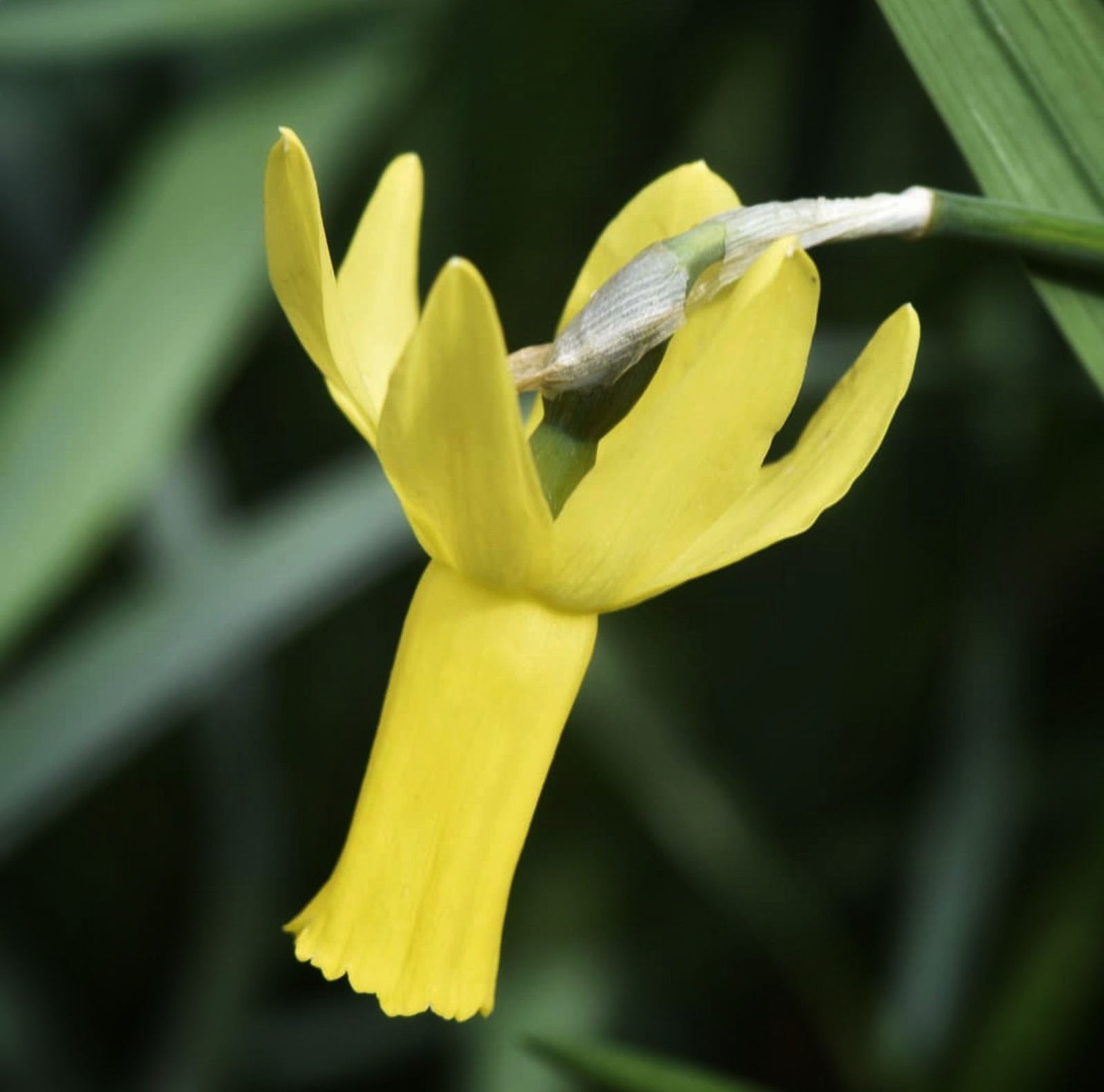
One of the top breeders of daffodils was Alec Gray, 1895-1986. He brought us 'Tête-à-Tête' for example, the greatest success of any bulb. 'Flomay' was named after his wife. Now you only name something after your wife if it is special and it is. Photographed here on 1st April 'Flomay' is a fabulous miniature, looking great in a pot. It is very slow to increase. Here's Alec's own description in his 1960 catalogue. I'm waiting for that pinkish edge to develop.

Subscribe to:
Posts (Atom)
